How a Drop Spindle Works
A drop spindle consists of a shaft (a straight wooden or metal rod) with a whorl (a disc or sphere) positioned near one end. The whorl adds rotational mass (a flywheel effect) that sustains the spin once the shaft is set in motion. The notch at the top of the shaft holds a half-hitch knot that connects the forming yarn to the spindle.
When the spindle is spun and allowed to hang freely from the yarn, the rotational force travels upward into the fibre being held in the spinner's hand. This twists the fibres together. By controlling how much fibre is in the drafting zone (the area between the spindle and the hand) and how fast the spindle rotates, the spinner determines the thickness and twist level of the resulting yarn.
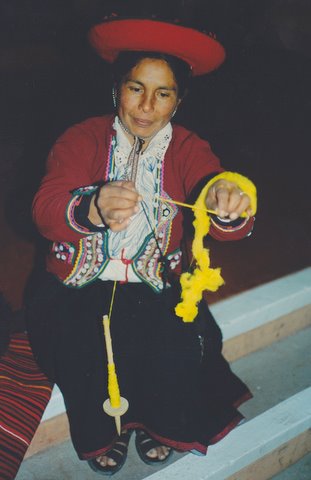
Choosing Spindle Weight
Spindle weight directly affects the yarn that can be produced. A heavier spindle (60–120g) sustains spin longer but pulls harder on the forming yarn — requiring a thicker, stronger single to avoid breaking. A lighter spindle (15–35g) produces less tension but loses momentum more quickly.
For beginners working with medium-staple Polish wool, a spindle of 50–70g is appropriate. This weight provides enough momentum for a slow drafter to maintain twist while learning to coordinate drafting with the spindle's rotation speed.
The whorl position also matters. A top-whorl spindle (whorl near the top of the shaft, notch above it) is the most common type for hand-held spinning. The notch sits at the spinner's eye level during drafting, and the spindle hangs below the work. Bottom-whorl spindles (whorl near the lower end) behave differently and are historically common in Eastern European textile traditions, including parts of Polish rural craft.
Attaching the Leader Yarn
A leader yarn is a short length of pre-spun yarn used to start the spindle before the new singles begin. It provides a stable anchor point and gives the spindle something to grip before the first fibres are introduced.
To attach a leader:
- Cut approximately 50 cm of spun yarn (any medium-weight single works)
- Tie one end around the shaft, just above the whorl, with a secure knot
- Wind the leader around the shaft in the direction the spindle will spin (clockwise for Z-twist, counter-clockwise for S-twist)
- Bring the yarn up to the notch and form a half-hitch around the notch tip
- Leave approximately 15–20 cm of leader hanging free above the notch

Joining Fibre to the Leader
To join the rolag to the leader:
- Tease apart the end of the rolag to form a thin tuft of loose fibres
- Overlap the tuft with the last 5 cm of the leader yarn
- Spin the spindle in the twist direction and allow twist to travel into the overlap zone, binding the rolag to the leader
- Once the join holds under light tension, begin drafting
The join is the weakest point in the early stages. Pulling too hard at the drafting zone before enough twist has entered the overlap will break the join and the spindle will fall.
Drafting Technique
Drafting is the process of drawing fibres apart to thin them before twist enters. Two common approaches:
Short Forward Draw
One hand (the back hand) pinches the yarn close to the spindle. The other hand (the front hand) slides forward along the rolag to thin the fibre supply, then releases, allowing twist to run up into the thinned section. This produces a denser, firmer yarn and gives the spinner greater control over thickness. It is appropriate for short- to medium-staple wool.
Long Draw
The front hand holds the fibre supply loosely and drafts back — away from the spindle — while the spindle hangs freely. Twist enters continuously. This technique is faster and produces a loftier yarn but requires the spinner to manage twist insertion actively. It is suited to medium-staple, well-carded fibre.
For medium-staple Polish wool prepared as rolags, short forward draw is the recommended starting point. It gives direct feedback on fibre thickness and makes it easier to correct inconsistencies in the yarn before they become permanent.

Winding On
As yarn accumulates below the notch, the spindle becomes heavier and the yarn between the notch and the spinner's hand grows longer. Before the spindle reaches the floor (or before the yarn becomes difficult to control), the wound-on section must be moved to the shaft.
- Release the half-hitch at the notch
- Wind the spun yarn onto the shaft below the whorl in an even cone shape
- Re-seat the half-hitch at the notch
- Continue spinning
Yarn wound on the spindle should be distributed symmetrically around the shaft to maintain rotational balance. Uneven winding causes wobble that disrupts the spin and fatigues the wrist.
Twist Direction
Z-twist (spinning the spindle clockwise when viewed from above) is the most common direction for singles. S-twist (counter-clockwise) is used when plying: two Z-twisted singles wound together with S-twist create a balanced 2-ply yarn that does not kink or unravel spontaneously.
Maintaining a consistent twist direction throughout a batch is necessary for even plying. If twist direction is inconsistent across the bobbin, the resulting 2-ply will have uneven texture.
Common Problems
- Yarn breaking at the drafting zone — usually indicates too little twist entering the fibre before the drafting hand pulls. Allow more spin to enter before drafting.
- Thick-and-thin sections — inconsistent drafting. Loading the card with an even layer and practising a uniform draw distance reduces this.
- Spindle dropping — the yarn broke or lost the half-hitch. Check that the notch is engaged before releasing the spindle to hang freely.
- Yarn curling on itself (snarling) — indicates over-twist. Reduce the number of spindle rotations per length of yarn drafted.
Related Articles
This article assumes the fibre has been washed and carded. See Washing Raw Fleece and Hand Carding Wool for the preceding stages of preparation.